

Summary
This paper analyzes the role of proteoglycans in skin aging, which is influenced by the presence of glycosylated proteins, within the diverse functions that proteoglycans perform in the skin. They are essential components that help regenerate cells, provide hydration, maintain the moisture of the extracellular matrix, prevent the formation of wrinkles due to their ability to bind with other molecules such as collagen or hyaluronic acid, and contribute to the smoothness of the skin structure. The use of these proteins is a very new and promising topic, as their application could revolutionize skin aging treatments. Among the existing proteoglycans, decorin, versican, and perlecan are of particular note for their key roles in the skin.
Introduction
Currently, skin aging is a topic that receives a great deal of interest because no one escapes this irreversible law. Aging is characterized by the appearance of morphological and physiological changes that occur over time in humans, leading to a decrease in the functional capacity of many tissues and organs.
This process has significant biological differences from one person to another; therefore, one of humanity's greatest ambitions is to prevent and combat skin aging, a challenge that we still face today [1, 2].
Skin is affected by changes caused by internal and external factors [3-5]. Intrinsic aging is biological aging. This is a genetically regulated process and is therefore inevitable. This process can be accelerated by environmental factors such as smoking or sun exposure [6-9], which are factors that cause so-called extrinsic aging. Based on those factors [10], we can say that skin aging is affected by inflammatory factors, hormonal levels, genetic regulation, the production of free radicals [11], exposure to UV radiation, environmental agents, etc. (Figure 1).

Among these factors, genome regulation clearly plays a key role, as it has been verified that at the genetic level, humans are 99% identical. And it is this 0.1% difference in DNA that makes us unique from one another. This 0.1% consists of genetic variants that play a role in regulating physical characteristics, such as skin color. Most genetic variants occur at the level of a single nucleotide polymorphism, named SNP (single nucleotide polymorphism). Each SNP represents an almost imperceptible difference in one of the units that make up DNA, the so-called nucleotide. SNPs often occur throughout a person's DNA. This leads us to believe that not all skin types are the same, and therefore, distinct products may be needed for skin care. Identifying the SNPs that exist in genes related to the aging process at such a skin level could allow us to know what skin type an individual will have, and therefore, we can determine each person's genetic profile and provide them with products suitable for their specific skin type, as well as to treat skin issues such as wrinkles and sagging [12, 13].
The role of telomeres is one of the factors that needs to be taken into account. It has been shown that telomere shortening is one of the most common causes of aging in all organisms. Telomeres are repetitive nucleotide sequences found at the ends of chromosomes. They are regions of DNA that do not fully replicate. With each cell division, the chromosome loses n repeats of nitrogenous bases. Telomerase is an enzyme with polymerase activity; in young people, it acts to replicate DNA at the ends of chromosomes, resulting in the extension of these telomeres. However, in older people, this process does not occur fully.
On the other hand, it has been noted that the increased production of free radicals, such as hydroxyl (-OH), is a primary cause of oxidative stress. Free radicals are reactive molecules capable of damaging cellular structures, including lipids and proteins, leading to the rapid appearance of visible signs of aging such as reduced elasticity and wrinkles. Under normal circumstances, humans develop DNA repair processes or neutralize free radicals with the skin's natural antioxidants. But over time, this ability diminishes, and consequently, macromolecules remain damaged due to the presence of these free radicals, creating an overload of oxidative stress and disorders related to the inability to repair the damage caused in cells, and thus causing skin aging.
The goal of this study is to determine the importance of using proteoglycans on the skin, highlighting their role in anti-skin aging and defining their functions in the skin.
Substances used to treat skin aging
Many compounds are used to treat or restore skin or prevent skin aging, for example [14]:
Vitamins, such as vitamin A (retinol) - also known as the anti-aging vitamin. Vitamin A is an antioxidant that acts on the skin, supporting cellular metabolism. It is essential for the correct functioning of epithelial cells. Its role in stimulating general metabolic activity through increased synthesis of collagen and GAGs (glycosaminoglycans) has been demonstrated. Other vitamins are also used alone or in combination with other compounds, such as vitamin E (tocopherol), vitamin C (ascorbic acid), and vitamin B5 (pantothenic acid).
Another compound widely used and recently become popular is Hyaluronic Acid (HA). It is a polysaccharide belonging to the glycosaminoglycan class that plays a formative role in the body's connective tissues, specifically in epithelial and nerve tissues. It is one of the main components of the extracellular matrix and plays an important role in the cell proliferation process. The main function of HA is to help retain large amounts of water in the body. Due to this property, hyaluronic acid is found in large quantities in our body - in bones, cartilage, tendons, skin, lips, etc. In the skin, hyaluronic acid is found along with collagen, and both are indispensable structural substances of the skin to maintain skin layers and structure. The skin of young people is very smooth and elastic because it has a high concentration of HA that keeps the skin healthy. With age, the skin loses its ability to maintain this hyaluronic acid concentration, and therefore the skin becomes drier, lacks necessary moisture, and develops wrinkles. Preclinical studies show that HC stimulates collagen tissue regeneration by increasing the synthesis of not only collagen but also auxiliary components (glycosaminoglycans and hyaluronic acid). Clinical studies show that continuous consumption of HC helps reduce and prevent joint pain, prevents loss of bone density and skin aging. These results, as well as its high level of tolerability and safety, have made oral HC an ideal choice for long-term use in degenerative bone and joint diseases and anti-skin aging [15, 16].
Polyphenols in green tea and aloe vera are also used [17], often in combination with other compounds.
It should be noted that, among the compounds currently in use, Argireline® [18, 19] is a peptide consisting of three amino acids: glutamic acid, methionine, and arginine. It has been shown to be effective in preventing the appearance of skin wrinkles and is identified as a specific weapon to fight against skin expression lines. Argireline® reduces the depth of these wrinkles, especially on the forehead and the eye area.
CoQ10 (ubiquinone): is one of the most common anti-aging compounds [20, 21]. Coenzyme Q10 is present in all cells in our body, with higher concentrations in the mitochondrial membrane. Over time, Coenzyme Q10 levels gradually decline, and therefore, the skin's antioxidant capacity also decreases. One of the visible benefits is that it acts on both collagen and elastin; therefore, it is often used in anti-aging formulas.
Melatonin: it has been discovered that reduced melatonin secretion increases the aging process. One of the most notable benefits of melatonin is that it acts as an antioxidant and cell protector, capable of neutralizing free radicals that cause tissue damage [22].
Dehydroepiandrosterone (DHEA): this endogenous prohormone is secreted by the adrenal glands and acts as a precursor for the production of sex hormones. It is involved in the production of estrogen and testosterone and is known as 'the youth hormone'. In recent years, this concept has become the subject of intense global debate. Our body begins to produce small amounts of this hormone at around age 7, reaches its maximum level at around age 25, and begins to decrease production by about 20% every ten years [23, 24].
Proteoglycans: these highly glycosylated proteins are found in the extracellular matrix of connective tissues such as the dermis and epidermis. The structural diversity of proteoglycans makes them diverse in terms of function both in the extracellular matrix and within cells. Proteoglycans are the fundamental components of the extracellular matrix of animals; therefore, they are the primary substance filling the space existing between the organism's cells. Here, they form large complexes, with other proteoglycans and with hyaluronic acid and proteins such as collagen, helping to maintain skin firmness and prevent the formation of wrinkles. Below, we provide a more detailed examination of the functions of proteoglycans, their uses, and their role in the skin aging process [25].
Proteoglycans
In connective tissue, most glycosaminoglycans (GAGs) bind to a central protein to form proteoglycans, which can range in size from 10 to 400 kDa [26]. The composition of glycosaminoglycan chains attached to central proteins (core proteins) makes up different proteoglycans (PGs). These GAG chains are linked to peptide chains through O-glycosidic bonds [27]. These GAGs are unbranched polysaccharide chains formed from repeating disaccharide units. One of these disaccharide units is always an amino sugar (a sugar molecule in which a hydroxyl group has been replaced by an amino group), and the other unit is a uronic acid. The number of GAGs attached to the central protein varies from 1 to more than 200 (Figure 2). A central protein can have identical GAGs attached to it, like versican, or different molecules, such as aggrecan.
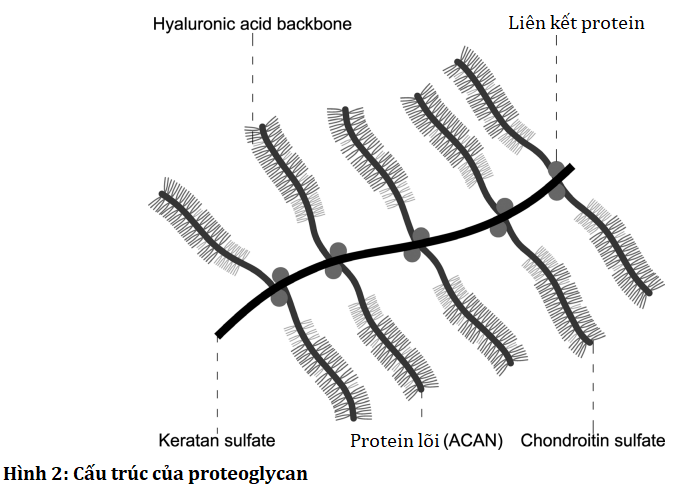
These proteoglycans can be located both in the extracellular matrix and in the plasma membrane or intracellular vesicles. The glycosaminoglycan chains located in the intercellular space have the ability to retain a large amount of water and resist external pressure. Therefore, they are responsible for providing mechanical support to tissue structures and allowing cells to migrate. Thus, proteoglycans are among the most important structural components of the extracellular matrix of the skin's connective tissues; having diverse functions, proteoglycans are present in the dermis and are essential to maintain the structural integrity of the skin.
Connective tissue, also known as conjunctive tissue, includes the following tissues: loose connective tissue, dense connective tissue, elastic tissue, adipose tissue, cartilage tissue, and bone tissue. This tissue is made up of cells, fibers, and a matrix. The fibers and matrix make up the extracellular matrix.
Connective tissue performs the following functions:
• Acts as support and bracing for organs such as bones and cartilage, which are the main organs responsible for supporting the human body.
• Nourishes other tissues, mainly epithelium.
• Protects and defends through plasmatic cells and macrophages, creating an immune system against foreign agents such as viruses and bacteria.
• Filling function, connecting adjacent structures together.
The extracellular matrix of connective tissue is the material that makes up most of the dermis, the rest being water and cells. A large part of this extracellular matrix is synthesized by fibroblasts, which are the most abundant cells in connective tissue and are responsible for synthesizing proteins such as elastin, collagen, and glycosaminoglycans.
This matrix is mainly formed from a complex mixture of proteins and sugars that form an ordered network of fibers and ground substance. Its main components are collagen and the proteins that make up elastic fibers, as well as proteoglycans and glycosaminoglycans, which perform various functions related to the skin.
The synthesis process of proteoglycans takes place in separate cellular compartments. The ribosome is responsible for synthesizing the protein component of the proteoglycan, which is transferred into the lumen of the rough endoplasmic reticulum. The glycosylation of proteoglycans occurs in the Golgi apparatus, and the entire proteoglycan is secreted in secretory vesicles that enter the extracellular matrix of the cell.
Because polysaccharide chains (glycosaminoglycans) have many negatively charged carboxyl and sulphate groups that attract a large number of positively charged particles, they play an important role in retaining large amounts of water in the extracellular matrix. For example, hyaluronic acid can hold water molecules 1000 times its molecular weight [28].
Classification
Based on the type of glycosaminoglycan attached to the protein and depending on the combination of disaccharide units in the proteoglycan, they can be classified into: chondroitin sulphate (CS), dermatan sulphate (DS), keratan sulphate (KS), heparan sulphate (HS), heparin (HP), and hyaluronic acid (HA)-type proteoglycans.
There are many types of proteoglycans such as decorin, biglycan, perlecan, versican, aggrecan, and syndecan.
• Aggrecan: found in cartilage and chondrocytes. It contains 100-150 keratan sulphate and chondroitin sulphate molecules. Its function is to maintain the hydration of the extracellular matrix in cartilage.
• Decorin and Biglycan: found in connective tissue, fibroblasts, cartilage, and bone, and they are proteoglycans very rich in leucine (a type of amino acid) with only one type of chondroitin sulphate or dermatan sulphate. Specifically, biglycan is expressed in mesenchymal tissues. They act on the collagen fibrillogenesis process because they bind to adjacent collagen molecules and contribute to the orientation of these fiber bundles. They regulate fibril thickness and interact with transforming growth factor-beta (TGF-β).
• Versican: it is located in fibroblasts, skin, smooth muscle, brain, and kidney mesangial cells. It binds to a protein and contains oligosaccharides and 12-15 chondroitin sulphate chains attached to the central protein.
• Syndecan: found in embryonic epithelium, lymphatic tissue cells, mesenchymal cells, lymphocytes, and leukocytes. It belongs to the transmembrane proteoglycan family containing heparan sulphate and chondroitin sulphate molecules in varying quantities. Its extracellular domain binds collagens, heparin, and fibronectin; its intracellular domain binds to the actin cytoskeleton.
• Perlecan: it is found in the basement membrane and belongs to the proteoglycan family with heparan sulphate-type glycosaminoglycan chains. It is present in a wide range of tissues, regulating many cellular processes such as bone and cartilage formation, inflammation, wound healing, and angiogenesis.
Proteoglycans in the skin
The most common proteoglycans of human skin are decorin, perlecan, and versican. It is particularly noteworthy that decorin interacts with collagen, and versican is located in the elastic fibers of the skin. Both proteoglycans play an important role in the changes that occur over time in human skin.

TCELL Joint Stock Company is the exclusive importer and distributor of international dermocosmetic brands in Vietnam.
Business registration No. 0315872501, issued by the Ho Chi Minh City Department of Planning and Investment on August 29, 2019.
Contact
3rd Floor, An Phu Plaza Building, 117–119 Ly Chinh Thang, Xuan Hoa Ward, Ho Chi Minh City
Customer service: 028 7306 9799
Partner hotline: 0937 476 499
Email: cs@tcelljsc.com